
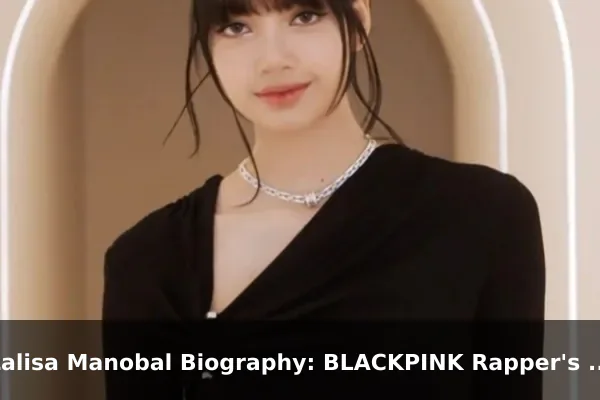
Lalisa Manobal Biography: BLACKPINK Rapper’s Global Rise is the story of a Thai-born performer who moved from a local dance background into one of the most internationally visible positions in modern pop. Known professionally as Lisa, she became famous as a member of BLACKPINK, but her career now stretches across K-pop, solo music, fashion, dance culture, brand partnerships, and a wider global entertainment market. Her rise matters because it shows how a performer from Thailand could become a central figure in a Korean pop group and then build a solo identity recognized far beyond one national industry.
This biography focuses on verified career milestones rather than rumor or fan mythology. The most reliable anchors are official sources: YG Entertainment’s BLACKPINK profile for her group membership, YG LIFE for the LALISA solo debut timeline, LLOUD for her current artist-management positioning, RCA Records for her international label context, and Guinness World Records for specific streaming achievements. Those sources help separate the lasting facts of Lalisa Manobal’s biography from the fast-moving noise that often surrounds global celebrities.
Lisa’s appeal is not built on one skill alone. She is widely recognized for sharp dance control, a confident rap tone, camera-ready performance instincts, and the ability to connect with audiences across languages and markets. This article traces that full journey: early life, training, BLACKPINK debut, signature style, solo breakthrough, independent-era development, and her cultural legacy so far.
Early Life in Thailand and Path to K-Pop

Lalisa Manobal was born in Thailand on March 27, 1997, a date reflected in official BLACKPINK member information and record references. Guinness World Records identifies her birth name as Pranpriya Manobal, while her public career has been built under the name Lisa and the fuller name Lalisa Manobal. For readers searching for a careful Lalisa Manobal biography, this distinction is important: Pranpriya belongs to her early personal history, Lalisa Manobal is the name attached to her global celebrity identity, and Lisa is the concise stage name that fans and media most often use.
Her early years are often described through a dance-first lens. Long before BLACKPINK became a global name, Lisa was known for performance ambition in Thailand. Many retellings of her pre-debut period point to youth dance teams, stage competitions, and an unusually early commitment to movement. Because early-life celebrity stories can become embellished over time, the safest reading is this: Lisa’s public career did not appear suddenly. It was built on years of performance practice before she entered the Korean idol training system.
From Local Performer to International Trainee
The bridge between Thailand and K-pop was an audition path. Lisa is widely reported to have been selected through a YG Entertainment audition in Thailand, after which she moved to South Korea for training. That move is one of the most decisive turning points in Lalisa Manobal’s career. It required not only talent, but adaptation: a new country, a new language environment, a demanding training routine, and the pressure of competing inside one of South Korea’s major entertainment companies.
For a young Thai trainee, the challenge was layered. She had to refine dance, rap, vocal presence, stage discipline, media confidence, and teamwork while also learning how to function in Korean entertainment culture. The result was not simply a polished idol. It was an artist whose identity would eventually become cross-border by design. Her biography therefore belongs not only to K-pop history, but also to a broader story of Asian pop culture becoming more interconnected.
Why Her Background Matters
Lisa’s Thai background has remained central to her public meaning. She is not just a non-Korean member in a Korean girl group; she is one of the most visible Thai artists in the global pop conversation. That visibility has inspired many younger fans in Southeast Asia who see her as evidence that international careers can begin outside the traditional centers of Western pop or Korean entertainment. Her background also adds cultural depth to BLACKPINK’s international image, giving the group a more varied identity than a purely domestic act.
At the same time, it is important not to reduce Lisa to a symbol. Her Thai identity matters, but her success is also rooted in years of disciplined training, musical releases, visual strategy, and repeated performance under intense public scrutiny. The most accurate biography holds both ideas together: Lisa is a Thai artist who represents a wider regional breakthrough, and she is also an individual performer whose rise depended on technical improvement and professional endurance.
Becoming Lisa of BLACKPINK
Lisa’s global rise accelerated with BLACKPINK, the YG Entertainment girl group that officially includes JISOO, JENNIE, ROSÉ, and LISA. YG’s official BLACKPINK profile continues to list Lisa among the members, placing her within the group identity that introduced her to a worldwide audience. Although BLACKPINK’s public history includes many chart, tour, and award milestones, Lisa’s role in the group can be understood through three connected functions: rap, dance, and performance impact.
BLACKPINK debuted in 2016 and quickly became one of K-pop’s most visible global acts. Lisa stood out because she brought a distinct rhythmic energy to the group. Her rap sections often offered contrast within BLACKPINK songs: sharper delivery after melodic vocals, playful tone in high-energy tracks, and movement-heavy performance moments that gave the stage a clear focal point. In music videos, choreography clips, and concerts, she became the member many viewers watched for dance precision and charismatic detail.
Rapper, Dancer, and Visual Performer
The phrase BLACKPINK rapper only captures part of Lisa’s role. She is also one of the group’s most recognized dancers, and her public image depends heavily on the relationship between sound and movement. In idol performance, rap lines are rarely just audio moments. They are staging moments, camera moments, styling moments, and crowd-response moments. Lisa built her reputation by making those seconds feel memorable.
Her dance style is often described as clean, controlled, and highly readable on camera. That matters in K-pop, where choreography must translate across live stages, music videos, fan cams, short-form clips, and global broadcasts. Lisa’s movements tend to have clear accents: sharp isolations, confident posture changes, and precise timing that help viewers recognize her even in group formations. Her performance strength is not only speed or difficulty; it is the ability to make choreography look intentional from beginning to end.
Team Identity Inside BLACKPINK
BLACKPINK works because each member projects a distinct identity while still fitting the group’s luxury-pop, hip-hop-influenced, and performance-forward concept. Lisa’s contribution sits at the energetic edge of that formula. JISOO brings a steady vocal and visual presence, JENNIE often bridges rap and pop star charisma, ROSÉ adds a recognizable vocal color, and Lisa supplies kinetic drive. This balance helped BLACKPINK become a group whose members could be recognized individually without weakening the collective brand.
That individual recognition became especially important as the group gained global attention. Fans did not only follow BLACKPINK as a unit; they learned each member’s style, personality, and artistic lane. For Lisa, that lane was built around international flair, dance authority, and a confident stage persona that could travel easily across cultures. It positioned her for later solo success without making her solo identity feel disconnected from the group.
Signature Performance Style and Global Appeal
Lalisa Manobal’s biography cannot be explained by discography alone. Her rise is deeply visual and physical. In the streaming era, music careers are shaped by short clips, choreography challenges, social platforms, fashion images, and fan-edited performance moments. Lisa fits that environment unusually well because her strengths are instantly legible. A viewer does not need deep K-pop knowledge to understand that she commands attention when she dances.
Her global appeal also comes from adaptability. She can appear polished in a luxury fashion setting, playful in variety content, intense in a performance video, and relaxed in social media-facing material. This range has made her valuable across entertainment categories. For SEO readers looking for BLACKPINK Lisa’s career profile, the key point is that her brand is not only musical. It is a combination of idol craft, dance authority, fashion visibility, multilingual fan connection, and modern celebrity media fluency.
Dance as a Core Identity
Dance is the foundation of Lisa’s artistic image. Many idols dance well, but Lisa’s reputation rests on how consistently dance has defined her. Her movement style emphasizes balance, speed control, and confident transitions. She can move with power without looking uncontrolled, and she can perform small gestures in a way that still reads clearly on camera. This is one reason her individual dance clips have circulated widely among fans and casual viewers.
Dance also gave Lisa a universal language. Rap lyrics may require translation, and interviews depend on subtitles, but movement can travel instantly. For a Thai artist working in Korean pop and reaching audiences in the United States, Europe, Southeast Asia, Latin America, and beyond, that nonverbal clarity is a major advantage. It allows her to connect with viewers even before they know her biography.
Rap Presence and Vocal Texture
As a rapper, Lisa often brings brightness and punch rather than a heavy underground tone. Her delivery is built for pop impact: memorable phrasing, confident attitude, and a sense of rhythm that supports choreography. In BLACKPINK’s songs, her lines often act as energy shifts. They change the texture of a track and give performances a moment of heightened confidence.
Her solo work continued this approach. Instead of presenting Lisa as a completely different artist, LALISA leaned into the qualities audiences already associated with her: bold sound, strong styling, dance-forward visuals, and a name-centered identity. That was a strategic choice. Her debut did not need to introduce an unknown performer; it needed to transform an already famous group member into a standalone solo brand.
Fashion and Image Strategy
Lisa’s visibility in fashion has strengthened her global profile. LLOUD’s official site describes her impact across music and fashion, a useful summary because her career now functions across both spaces. Fashion appearances, magazine projects, luxury-brand imagery, and red-carpet moments all contribute to the public understanding of Lalisa Manobal as a global celebrity rather than only a K-pop idol.
This matters because modern pop fame is increasingly interdisciplinary. A performer can gain cultural power through songs, but also through styling, visual campaigns, social media presence, and association with influential creative houses. Lisa’s image is especially effective because it can move between streetwear energy, high-fashion polish, and stage-ready intensity. That flexibility makes her recognizable in many contexts without diluting her core identity.
Solo Breakthrough with LALISA

Lisa’s solo debut was a major turning point. YG LIFE announced that BLACKPINK Lisa would make her solo debut on September 10, 2021, with a first solo single album titled LALISA. The announcement emphasized the use of her real name as the album title and framed the release as a project aimed at the global music market. That context is important: from the beginning, Lisa’s solo launch was positioned not merely as a side release for existing fans, but as a global statement.
LALISA worked as both a song and a declaration of identity. The title placed her name at the center, while the visual concept highlighted confidence, performance power, and personal branding. For an artist known through a group, naming the debut after herself made the message direct: Lisa was stepping forward as a solo performer with a recognizable artistic signature.
The Meaning of a Name-Centered Debut
A name-centered debut can be risky because it depends on whether the performer already carries enough cultural weight. In Lisa’s case, it made strategic sense. By 2021, she had years of BLACKPINK exposure, a large international fan base, strong dance credibility, and a public image that was already distinct. The name LALISA therefore did not feel like an introduction from zero. It felt like the formal naming of a global persona that fans had watched develop.
The single album format also matched the K-pop market. Guinness World Records explains that a single album can be a physical release featuring one or more singles, distinct from a traditional one-track digital single. This format gave Lisa a focused solo package without requiring a full-length album at the debut stage. It kept attention on the title track and the follow-up track MONEY, both of which became central to her solo story.
Verified Streaming Milestone
The most concrete record milestone tied to Lisa’s solo debut comes from Guinness World Records. Guinness records LALISA as the first album by a solo K-pop artist to reach 1 billion streams on Spotify, with the milestone achieved on April 28, 2023. Guinness also notes that the milestone came 595 days after the September 10, 2021 release and was achieved with two tracks: LALISA and MONEY.
That achievement is significant because it gives Lisa’s solo success a verifiable benchmark. Fan enthusiasm is powerful, but official records provide a clearer measure of impact. A billion Spotify streams for a two-track single album shows that Lisa’s audience did not only support a debut-week moment. Her songs continued to circulate internationally long after release, especially through streaming playlists, social media clips, dance content, and fan communities.
Why MONEY Extended the Era
MONEY became especially important because it extended the life of the LALISA era. While the title track carried the identity statement, MONEY offered a performance-friendly hook that traveled strongly across short-form video and dance spaces. Its impact helped show that Lisa’s solo appeal could survive beyond the initial curiosity of a famous idol debuting alone.
This is one of the clearest signs of her global rise. A solo debut can generate attention because of a group fan base, but a song that keeps moving across platforms creates a different kind of proof. It suggests that the artist’s style, performance language, and sonic branding can function independently. For Lisa, MONEY helped turn a successful debut into a longer solo campaign.
Beyond BLACKPINK: LLOUD, RCA, and a Wider Pop Career
After the LALISA era, Lisa’s career entered a broader phase. The official LLOUD site presents LLOUD as an artist management company focused on genre-crossing experiences and lists Lisa as its artist. The site describes her as renowned as a member of BLACKPINK while also highlighting her wider impact in music and fashion. This language is useful because it reflects how her current positioning works: she remains tied to the BLACKPINK identity that made her famous, but she is also building a wider solo platform.
RCA Records also lists LISA on its official artist roster, giving her solo career a visible connection to a major international label environment. In practical terms, label and management structures can change over time, so readers should always check current official pages for the latest details. As of the official sources reviewed for this article, LLOUD and RCA are key anchors for understanding Lisa’s post-debut solo direction.
The LLOUD Era
LLOUD signals a more self-defined chapter in Lalisa Manobal’s biography. The name itself suggests volume, confidence, and public presence, which fits Lisa’s existing performance identity. More importantly, it gives her solo career a dedicated official platform. Instead of relying only on group channels or older agency pages, LLOUD can present her projects, fashion work, music updates, and public-facing creative direction in one place.
This matters for a global artist because audiences now follow careers across many channels. A fan might discover Lisa through BLACKPINK, follow her through a fashion campaign, stream her solo music through a label link, and check official management pages for updates. LLOUD helps organize that ecosystem. It is not only a business detail; it is part of how Lisa’s independent-era identity is communicated.
RCA and International Pop Positioning
RCA’s roster context places Lisa beside a wide range of pop, R&B, hip-hop, rock, and global artists. That does not mean her music must abandon K-pop influences. Instead, it suggests a broader release and promotion environment where she can reach listeners who may not follow Korean entertainment closely. This is the next logical step for an artist whose audience already spans continents.
The challenge in this phase is balance. Lisa’s strongest public identity is tied to the performance precision of K-pop and BLACKPINK, but international pop markets often reward individual storytelling, radio strategy, collaborations, and album-scale artistic framing. Her future success will depend on how well she keeps the strengths that made her recognizable while expanding the musical range expected from a solo global artist.
Projects, Fashion, and Entertainment Expansion
LLOUD’s official project listings point to a career that is not limited to music releases. Fashion partnerships, editorial projects, and visual campaigns have become part of Lisa’s public work. This is consistent with the broader direction of celebrity culture, where global artists operate as performers, style figures, brand collaborators, and media personalities at the same time.
For readers following Lalisa Manobal’s global rise, this wider activity should be understood as part of the biography rather than a distraction from it. Lisa’s career has always been visual. BLACKPINK’s success depended heavily on performance, styling, music video language, and stage charisma. Her solo era simply expands those same strengths into new professional spaces.
Cultural Impact and Legacy So Far
Lisa’s cultural impact begins with representation but does not end there. As a Thai performer in one of K-pop’s most famous groups, she helped make the idea of a multinational idol lineup feel more globally visible. K-pop had international members before BLACKPINK, but Lisa’s scale of fame made her a particularly powerful example. Her success encouraged audiences to think of K-pop not only as a Korean export, but as a regional and global pop system where talent can move across borders.
Her impact is also visible in dance culture. Many fans and aspiring performers study her stage clips to understand timing, posture, attitude, and camera engagement. This kind of influence is difficult to measure in a single statistic, but it is central to why Lisa’s name remains so searchable. She is not just listened to; she is watched, copied, analyzed, and used as a reference point for performance standards.
Influence on Thai and Southeast Asian Fans
For Thai fans, Lisa’s success carries a special emotional weight. She represents a path from Thailand to global entertainment without erasing her origin. Her presence in BLACKPINK and her solo achievements have helped widen the imagination of what a Southeast Asian performer can do in mainstream pop. That influence is especially meaningful for young dancers, singers, and trainees who may see her career as proof that global stages are not reserved for artists from a small number of dominant markets.
At the same time, Lisa’s success should not be treated as a simple blueprint. Her path involved unusual timing, major-agency training, intense competition, and the massive platform of BLACKPINK. What makes her biography inspiring is not that it is easily repeatable, but that it changed the visible possibilities for artists from her region.
BLACKPINK’s Global Context
Lisa’s rise is inseparable from BLACKPINK’s rise. The group became a major international force through music videos, streaming platforms, touring, fashion partnerships, and a highly recognizable four-member structure. Lisa benefited from that platform, and she also helped strengthen it. Her dance reputation, rap presence, and international identity contributed to BLACKPINK’s distinct global appeal.
This mutual relationship is important. Some celebrity biographies frame solo success as an escape from a group identity, but Lisa’s case is better understood as expansion. BLACKPINK gave her the global stage; Lisa’s solo work proved she could stand at the center of that stage alone. The two identities continue to inform each other.
Key Career Milestones in Lalisa Manobal’s Biography
A concise timeline helps show how Lisa’s career developed from trainee promise to global recognition. The exact details of early training are often summarized differently across media outlets, but the major public milestones are clearer when tied to official sources and verified records.
- March 27, 1997: Lalisa Manobal was born in Thailand, with Guinness World Records identifying her birth name as Pranpriya Manobal.
- Pre-debut years: Lisa developed a performance background in Thailand before entering the Korean idol training system.
- 2016: BLACKPINK debuted, introducing Lisa internationally as part of YG Entertainment’s four-member girl group.
- September 10, 2021: Lisa released her first solo single album, LALISA, according to YG LIFE’s official solo debut announcement.
- April 28, 2023: Guinness World Records records LALISA as reaching 1 billion Spotify streams, becoming the first album by a solo K-pop artist to do so.
- Current solo era: LLOUD presents Lisa’s wider artist-management identity, while RCA Records lists LISA on its official roster.
These milestones show a career built in phases. First came training, then group identity, then solo proof, then broader international positioning. That sequence is one reason Lalisa Manobal’s biography continues to attract readers: it is still developing, but it already contains several distinct chapters.
What Makes Lisa’s Rise Different
Lisa’s story stands apart from many idol biographies because it combines several rare factors. She is a Thai artist who became famous through a Korean group, a dancer whose performance clips travel globally, a rapper whose stage presence became part of BLACKPINK’s sound, and a fashion-facing celebrity with major international visibility. Many artists have one or two of those elements. Lisa has all of them operating at once.
Her rise also reflects a shift in how pop careers are built. Earlier generations often depended heavily on radio, television, or domestic album sales. Lisa’s career grew through music videos, social platforms, fan communities, streaming metrics, fashion media, and global touring culture. That environment rewards artists who can be understood quickly across languages. Lisa’s performance style is particularly suited to that kind of media landscape.
Strengths That Define Her Brand
Several qualities appear repeatedly throughout Lisa’s career:
- Performance clarity: Her dance lines and stage gestures are easy to recognize, even in fast choreography.
- International identity: Her Thai background, Korean training, and global audience make her career inherently cross-cultural.
- Visual adaptability: She can shift between music-video intensity, luxury fashion, editorial styling, and casual fan-facing content.
- Name recognition: Lisa is a short, memorable stage name, while Lalisa Manobal gives her solo identity a fuller personal dimension.
- Verified momentum: Her solo streaming record gives measurable weight to her global popularity.
These strengths explain why Lisa’s biography is not limited to one fan community. She attracts K-pop fans, dance watchers, fashion audiences, Thai and Southeast Asian supporters, and global pop listeners. Her career sits at the intersection of all those groups.
Conclusion: Lalisa Manobal’s Global Rise Is Still Being Written
Lalisa Manobal Biography: BLACKPINK Rapper’s Global Rise is ultimately a story of movement: from Thailand to South Korea, from trainee rooms to BLACKPINK stages, from group fame to solo records, and from K-pop celebrity to wider global entertainment. Lisa’s success was not created by one viral moment. It came from years of preparation, a powerful group platform, disciplined performance craft, and the ability to turn visual charisma into international recognition.
The official record already gives her biography strong foundations. YG Entertainment lists her as part of BLACKPINK, YG LIFE documents the September 10, 2021 solo debut of LALISA, Guinness World Records verifies a billion-stream Spotify milestone, LLOUD frames her current management-era identity, and RCA Records places LISA within a major international roster context. Together, those anchors show an artist whose career has moved from promising trainee to documented global figure.
Her legacy so far is especially meaningful because it extends beyond personal fame. Lisa has expanded the visibility of Thai talent in global pop, raised the performance standard associated with idol dance, and shown how a K-pop group member can build a solo identity without severing the connection to the group that shaped her. The next chapters of Lalisa Manobal’s biography will depend on new music, creative choices, collaborations, and the direction of her solo platform. What is already clear is that her rise has become one of the defining international pop stories of her generation.
Official references
- YG Entertainment BLACKPINK Profile – Official BLACKPINK artist profile for Lisa's group membership, member details, social links, and group achievements.
- YG LIFE: LISA Solo Debut Announcement – Official YG announcement for Lisa's solo debut timeline and LALISA release context.
- LLOUD Co Official Website – Lisa's current official management/artist site, useful for current solo career positioning and official project links.
- RCA Records – Official label site for verifying Lisa's current RCA Records affiliation and roster context.
- Guinness World Records: LALISA Spotify Record – Primary records authority for verified Lisa career milestones, dates, and achievement wording.
